Guides ·
How to Use EXIT HOUSE: Exit Unwanted NFTs and Tokens for EXIT
By Anthony Anger · 4 min read

Many NFTs and tokens sit in wallets long after their owners have stopped caring about them. EXIT HOUSE gives them a deliberate exit: you retire the asset on-chain, permanently, and receive EXIT in the same transaction.
This guide walks through a real exit from start to finish: what you need, what qualifies, how your quote is put together, and what happens when you sign.
What you need
- An Ethereum wallet. EXIT HOUSE is non-custodial and needs no account.
- An eligible NFT, or an amount of an eligible ERC-20 token.
- ETH for gas and for the exit fee, which is 2% of the asset's qualifying value.
What can exit
NFTs can exit from any ERC-721 or ERC-1155 collection that was live on OpenSea before October 1, 2026, and has had at least five sales in the past 30 days. Each NFT follows its collection's rules.
An ERC-20 token qualifies if it was deployed on Ethereum before October 1, 2026, has a Chainlink price feed or a Uniswap market holding at least $250,000, and transfers exact amounts. Fee-on-transfer and rebasing tokens are refused.
NFTs that are financial positions, such as Uniswap liquidity positions and Lido stETH withdrawal NFTs, can't exit, and neither can EXIT itself.
Step 1: Connect your wallet
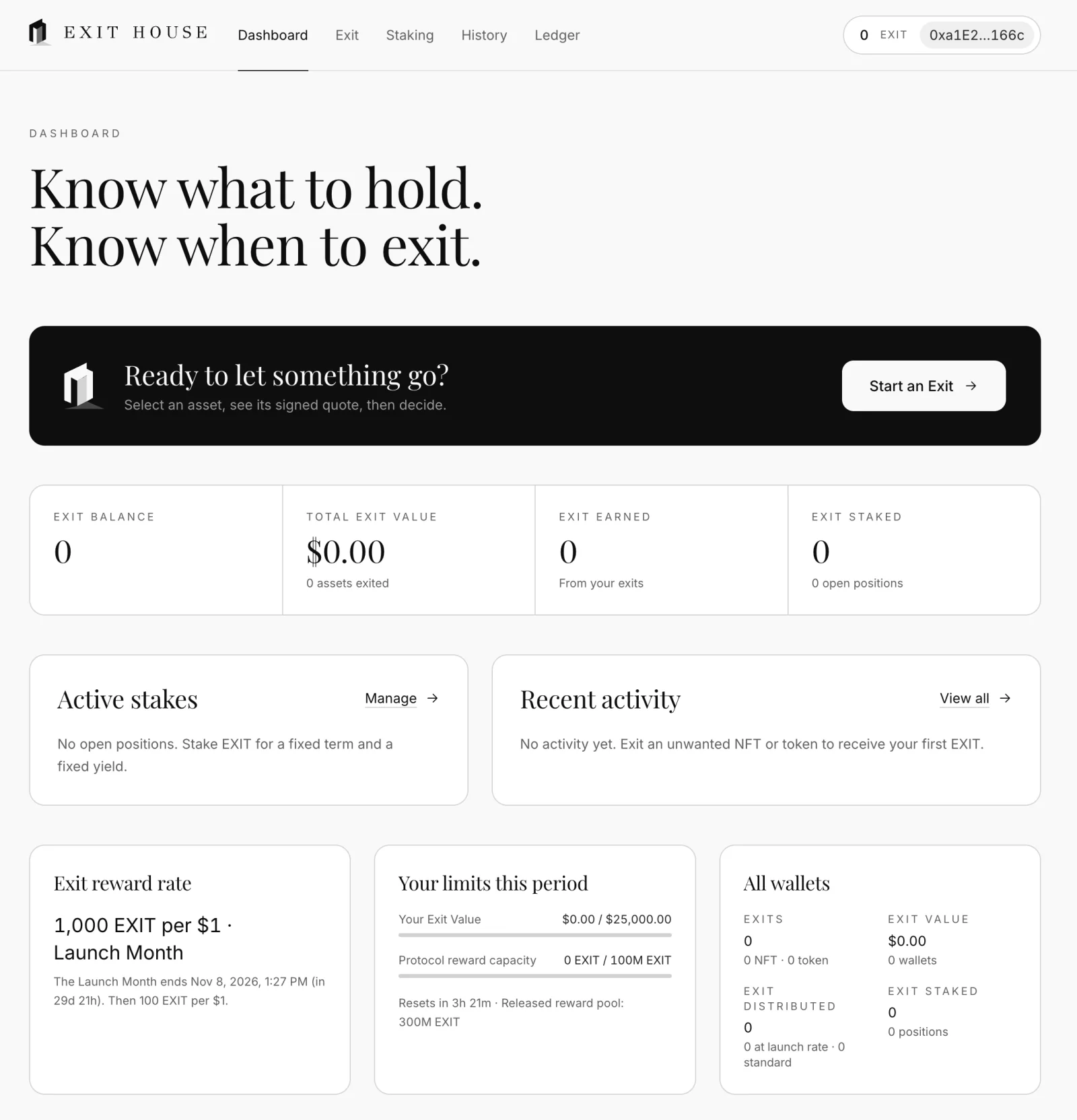
Open the dashboard and connect any Ethereum wallet. EXIT HOUSE never holds your assets: everything happens from your own wallet, in transactions you sign.
Step 2: Choose what to exit
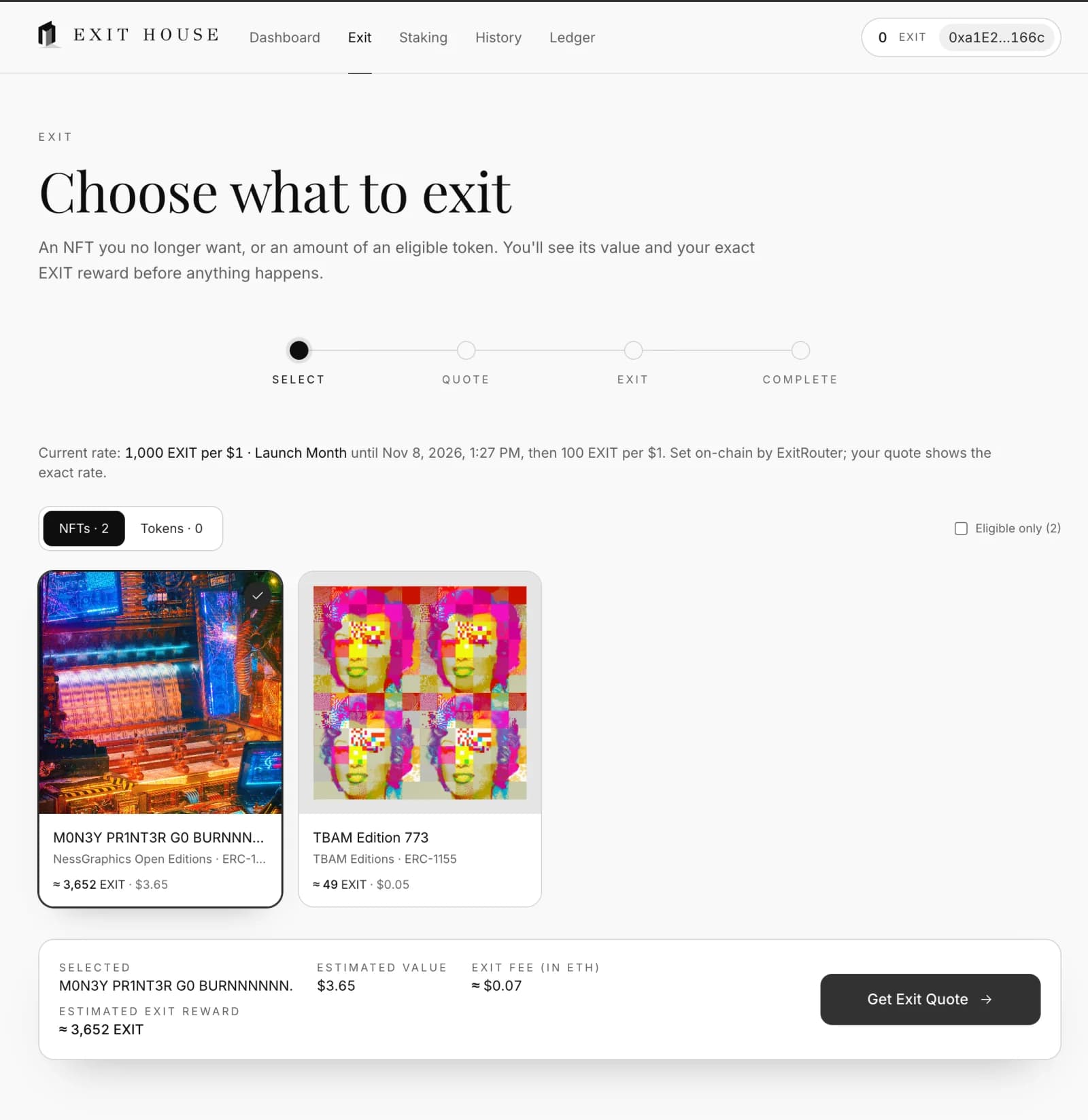
Choose Start an Exit, then pick an NFT, or enter an amount of a token. Each eligible asset shows an estimated value and EXIT reward. Assets that aren't eligible, or have no trustworthy price, are shown but can't be selected: EXIT HOUSE would rather show a price as unavailable than guess it.
With an asset selected, choose Get Exit Quote.
Step 3: Review your signed quote
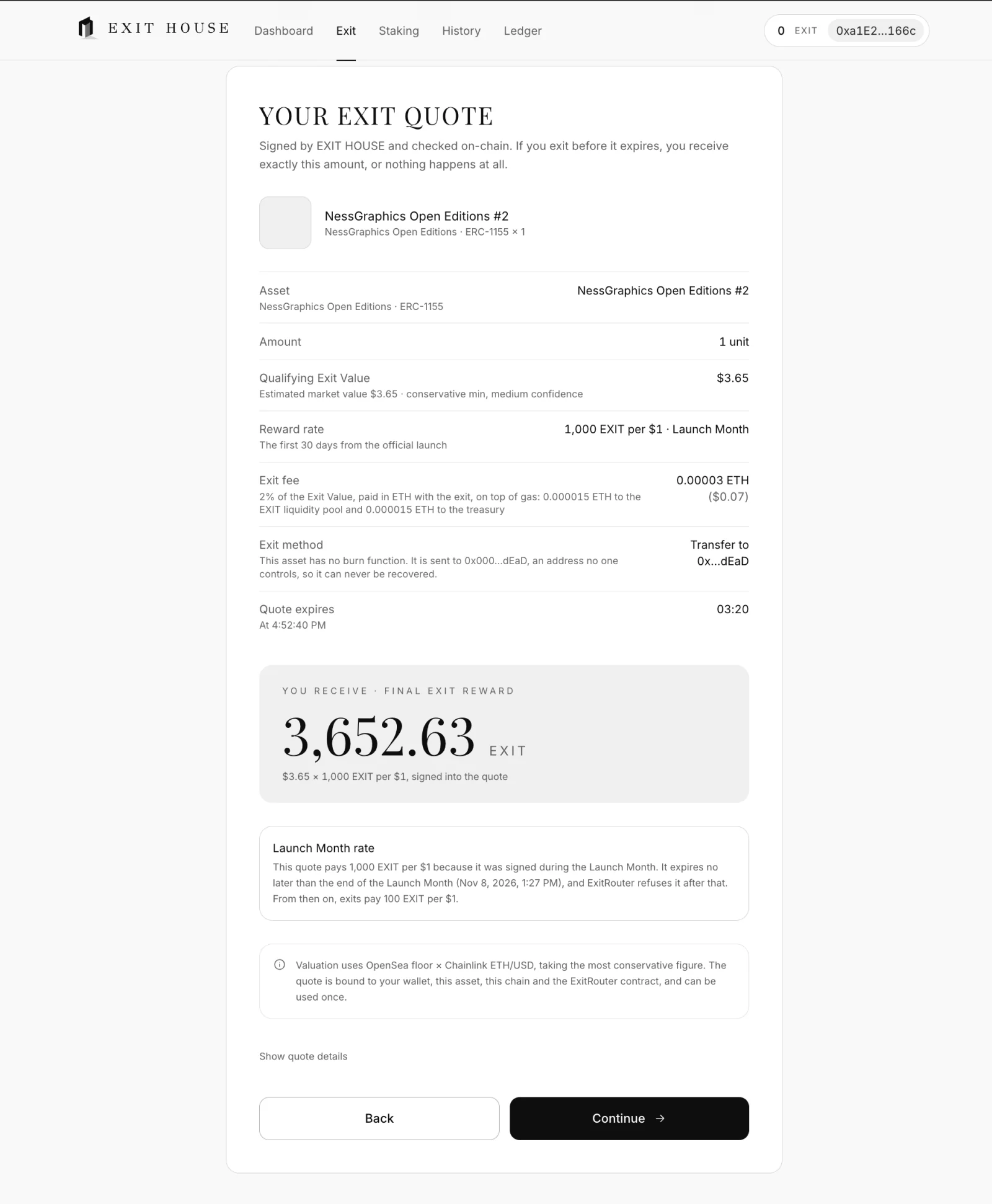
EXIT HOUSE values the asset from market data and signs a quote. It shows the asset and amount, the qualifying Exit Value, the reward rate, your exact EXIT reward, the exit method, the fee and when the quote expires.
An NFT is valued at the higher of its collection's OpenSea floor price and best collection offer, capped at twice the collection's 30-day average sale price. A token is valued at its Chainlink price or, without one, from its deepest Uniswap market, at the lower of the 30-minute average and the current price.
The quote is bound to your wallet, the asset, the amount and the ExitRouter contract. It works once and expires within minutes, so the numbers you approve are the numbers you get. If it all looks right, choose Continue.
Step 4: Approve, then exit
Before your first exit, EXIT HOUSE asks you to accept the risks and the Terms. Then confirm that you understand the exit is irreversible, and choose EXIT ASSET (EXIT TOKEN for a token).
An exit takes two transactions. First you approve the exit adapter: a token for exactly the quoted amount, an NFT for that one token, or an ERC-1155 for its collection. An approval already in place is used again.
Then you exit, paying the fee in ETH with the transaction: 2% of the Exit Value, 1% for the EXIT liquidity pool and 1% for the treasury. The fee is on top of gas and doesn't reduce your reward.
Some assets are burned with their own burn function; the rest are sent to 0x…dEaD, an address no one controls. Your quote shows which. If any check fails, the whole transaction reverts and nothing leaves your wallet.
Step 5: Receive EXIT
The quoted EXIT arrives in the same transaction, paid from the protocol's reward vault. Every exit is recorded on-chain and appears in your History.
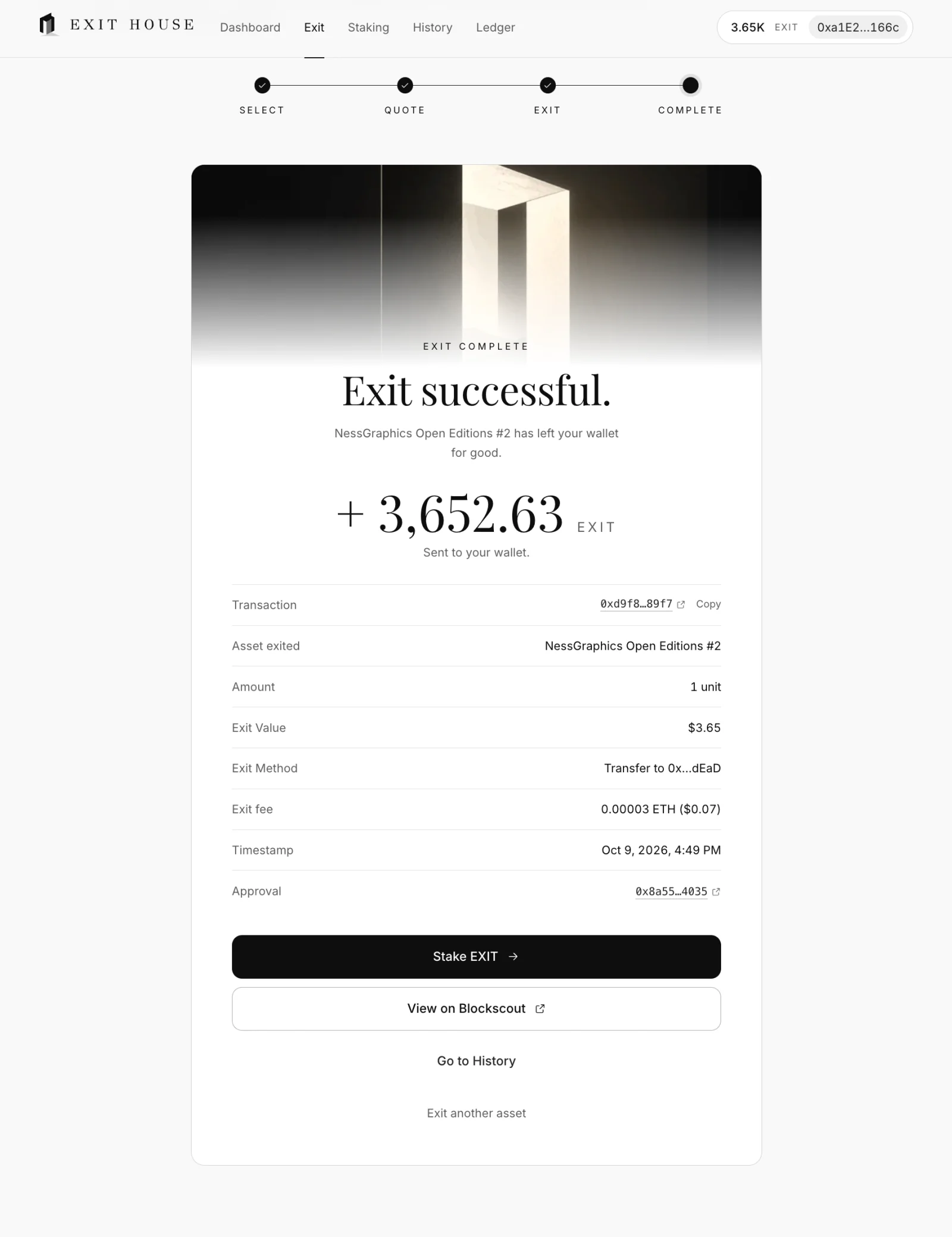
During the Launch Month, until November 8, 2026, at 18:27 UTC, each exit pays 1,000 EXIT for every $1 of qualifying value. After that, the rate is 100 EXIT per $1. An NFT valued at $250 pays 250,000 EXIT in the Launch Month and 25,000 EXIT after it.
Optional: stake your EXIT
You can lock EXIT for a fixed term of 7 to 360 days. Each term pays a fixed reward, set when you stake and paid at maturity. There's no early withdrawal and no automatic rollover: at maturity, you claim or restake. Staking shows the current terms.
Limits worth knowing
- An exit must be worth at least $0.10.
- Each exit counts at most $5,000 of qualifying value; an asset worth more is capped at $5,000.
- Each wallet can exit up to $25,000 of qualifying value a day.
- Each collection or token can take up to $10,000 of exits a day.
Before you exit
An exit is permanent. Once the transaction confirms, the asset is gone for good, and blockchain transactions can't be undone. EXIT's price is set by the market and can change. Read the Risks and the Terms before your first exit.
For more detail, read How It Works and the whitepaper, or write to caretaker@exit.house.